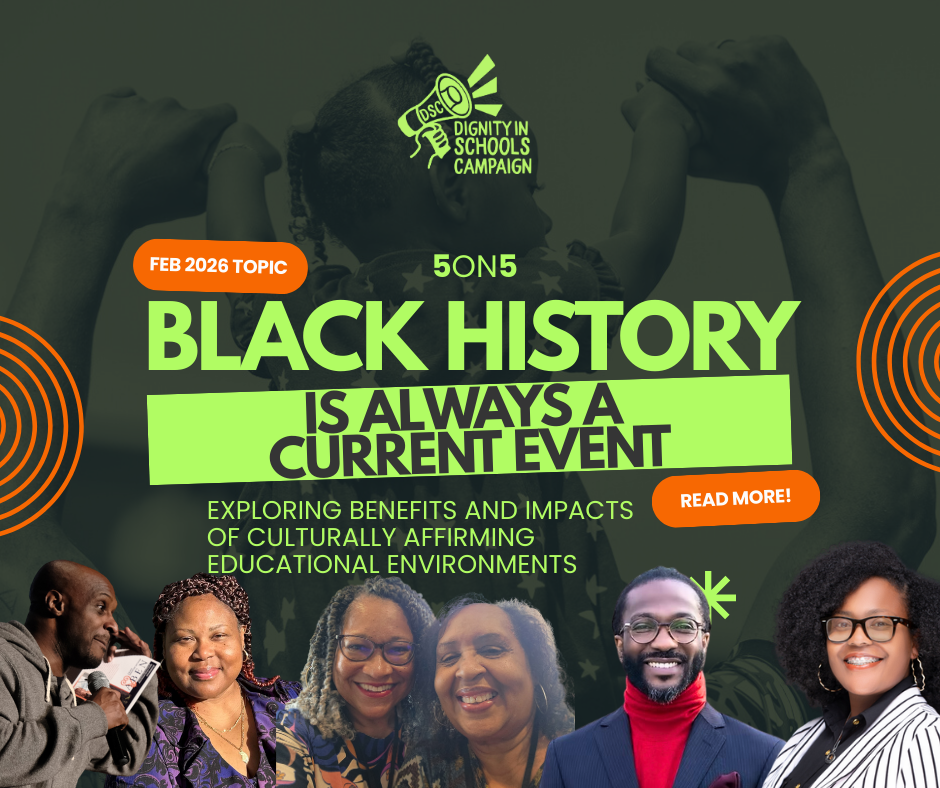
Black history isn’t just about the past—it’s a lens for understanding the present. For this 5on5 feature, we asked five members to reflect on the theme, “Black History Is Always a Current Event: Exploring the Benefits and Impacts of Culturally Affirming Educational Environments.” They consider who holds power over what students learn, what young people absorb when schools avoid honest conversations about racism and resistance, and what could change if public education truly centered Black history and community wisdom. Together, their insights affirm that culturally affirming education is essential to building informed, empowered communities.
1. How does learning real Black history help students make sense of what’s happening in the world right now?
 Jason B. Allen (JBA) – National Parents Union: I believe teaching the authentic history of Black and indigenous people in America begins at home. Our children must first see their family/village and their significance to the Earth in order to truly appreciate the gifts, talents and sacrifices of others in the advancement of people of color.
 Dr. Shequite Johnson (SJ) – GAP Leadership: Learning real Black history gives students context. It helps them see that what they are witnessing today did not happen in isolation or overnight. Policies, protests, inequities, and movements all have roots. When students understand the long arc of Black resistance, innovation, and survival, they are less confused and less internalizing blame. They begin to recognize patterns, power, and progress, and they gain language to describe their own experiences. History becomes a tool for interpretation rather than a list of dates.
 Hashim Jabar (HJ) -Racial Justice NOW!: The current president is like Andrew Jackson and his administration. Learning about the history of the U.S. and the enslavement of a mass population, point to many comparisons that can be made from then to now. Students would be able to see how government policy of the past, such as the treatment of Native Americans, is similar to how the current Presidential administration is operating and communicating.
 Vickie Fornville (VF) – Hannah Ruth Foundation: Learning Real Black History helps our students by allowing them to see where we have been. Our students need to understand where we came from so that they can understand the possibility of where they can go and grow. We didn’t start our history when our people arrived in this country. We lived and thrived prior to that time. They also need to learn about what our people provided to this country. If our students aren’t taught about what our people contributed to this nation and world, we are doing them a huge disservice.
 Linda Reid & Rosie Grant (LR & RG) – Paterson Education Fund: Learning Real Black History helps our students by allowing them to see where we have been. Our students need to understand where we came from so that they can understand the possibility of where they can go and grow. We didn’t start our history when our people arrived in this country. We lived and thrived prior to that time. They also need to learn about what our people provided to this country. If our students aren’t taught about what our people contributed to this nation and world, we are doing them a huge disservice.
2. Who has the most power in deciding what students learn—and who should have more of a say?
JBA: The ultimate power lies with the teacher and how the text is taught and presented. However, the school board passes policies and administrators enforce them so power dynamics exist among the system, the administrator and the teacher.
SJ: Right now, the greatest power sits with policymakers, curriculum publishers, and political interests that are often far removed from classrooms and communities. Teachers, parents, students, and local communities should have far more influence. Those closest to the impact understand what students need to feel seen, informed, and prepared. Education works best when it is shaped with communities, not imposed on them. More importantly, no one knows best what the needs of a student are better than the student themselves.
HJ: Currently, State Board of Education members and Superintendents likely have the most power. Parents should have a strong influence as well as community members that pay for the school through taxes.
VF: Currently our federal government has the most power in deciding nationally what our students are learning in school. But that doesn’t mean that there isn’t power on the local levels. Local school systems have power as well. Parents and community members can and should talk to their local school boards to make sure they know what their concerns are about what our students are being taught. If our students can learn the history of other races, religions and cultures we should be learning the real history about our own.
LR & RG: Right now, state standards, district leaders, and school boards hold most of the power over what gets taught. Those decisions often happen far from the classrooms and communities most impacted by them.
But families, students, educators, and community organizations should have a much stronger voice. The people closest to young people understand what they are navigating and what knowledge would truly prepare them to thrive. Curriculum should not be shaped only by politics or standardized testing priorities It should reflect lived experience and community wisdom.
When communities are meaningfully included in decision-making, education becomes more relevant and more powerful. Students are more engaged when they see themselves and their histories reflected in what they learn. If we want schools to work for our children, the community must be at the table, not just informed after decisions are made.
3. What are students really learning when schools avoid teaching about racism or resistance?
JBA: Students are often being taught what the system wants them to know, rather than being taught how to learn. Students are really learning a version of history and how systems work through the eyes of those positioned to oppress or control others. This is why teachers and parents should play a pivotal role in selecting and or creating the curriculum.
SJ: They are learning silence which is intentional. They are learning that discomfort matters more than truth. They are learning that their realities are either invisible or inappropriate for academic spaces. We have to ask ourselves, is this really what we want to force upon our future leaders? When resistance is erased, students miss the lessons of courage, strategy, and collective action. Avoidance teaches compliance rather than critical thinking, and it leaves students unprepared to engage the world honestly.
HJ: Students learn ‘western civilization’ from a lens that European culture is dominant and the best.
VF: They are learning that what happened to our people doesn’t matter and we aren’t valuable. They need to know that resistance is a form of power for people. To not teach the history of resistance in this country leaves a void in the truth. All different types of people came together to fight against what was wrong and to uplift what was right. To not teach the truth, harms our students because they are left not understanding how different people can come together for the common good of mankind.
LR & RG: When schools avoid teaching about racism or resistance, students learn that some truths are too uncomfortable to name. They learn that injustice is either invisible or unimportant. For students of color especially, silence can feel like erasure.
Young people are not naïve. They see inequality in their communities and online every day. When schools refuse to address it, students may begin to distrust the institution itself. Avoidance teaches compliance, not critical thinking. It sends the message that maintaining comfort matters more than confronting harm.
On the other hand, learning about resistance movements, local and national, teaches students that people have always organized for change. It shows them that ordinary people can challenge unfair systems. That kind of education doesn’t divide students; it equips them with the tools to participate in democracy and advocate for themselves and their communities.
4. What fears—real or imagined—stop educators from fully embracing culturally affirming education?
JBA: Most educators fear losing their certification and their paycheck for teaching inclusive, culturally affirming curriculum. This is why I believe early education at home and in grade school is key to giving our children a firm academic and cultural foundation.
SJ: It is important to recognize that many educators come from the very communities that are most vulnerable. They have navigated barriers, persevered, and in many cases “made it out” simply to survive and make ends meet. Yet, even with those lived experiences, many feel unable to fully embrace culturally affirming education due to fears of backlash, threats to job security, political pressure, or being labeled as divisive. Some fear saying the wrong thing or being openly challenged. Others were never trained, even while earning their degrees, to teach beyond a narrow framework, leading them to mistake neutrality for professionalism. These fears are often reinforced by systems that punish truth-telling rather than support growth, learning, and courage. That is why I deeply admire the work of Dignity in Schools, because you are creating space for educators and communities to reclaim power and be in control of our own narratives.
HJ: From experience, teachers are nervous that they won’t know how to deal with the reactions (emotional) of students. They feel that students may even see them (Europeans) in a negative light and lose ALL connection to the students.
VF: The fear of losing their jobs and being publicly attacked is a real thing with educators these days. In some places educators have been physically assaulted or worse for trying to teach the truth. These are some harsh realities, but there are educators left who are standing on the frontlines teaching students the truth in a culturally affirming manner.
LR & RG: Some fears are very real. Educators worry about political backlash, angry school board meetings, social media attacks, or even threats to their jobs. In today’s climate, talking honestly about race can feel risky.
There are also fears rooted in uncertainty. Many teachers were not trained to facilitate conversations about race, identity, and power. Without strong professional development and institutional support, they may worry about saying the wrong thing or facing conflict in the classroom.
But avoiding the topic does not protect students, it leaves them unsupported. When educators receive training, clear policies, and backing from leadership, they are much more confident creating culturally affirming spaces. The real solution isn’t silence; it’s support. If we want courageous classrooms, we have to build systems that protect and prepare the adults leading them.
5. If public education truly centered Black history and community wisdom, what long-term changes might we see in our neighborhoods?
JBA: Public education can center Black history and cultural wisdom through teaching life skills that would help a) reduce the school-to-prison pipeline, b) provide financial literacy increasing economic advancement and c) prepare more youth to be builders and self-sufficient in systems created by them or others.
SJ:We would see students with stronger identities, deeper empathy, and a clearer sense of responsibility to their communities. Schools would become spaces of healing and empowerment rather than alienation. Over time, that translates into higher civic engagement, stronger leadership pipelines, reduced harm, and communities that are better equipped to advocate for themselves. When education honors people’s histories and wisdom, it builds both knowledge and agency. More so, we are able to create legacies that can be passed down from one generation to the next.
HJ: Increased confidence, more cooperative activity, increased pride.
VF: Pride will show up and show out! Our students and communities will start to demand more opportunities. We will have villages of connected people who want to see eachother grow and succeed.
LR & RG: If public education truly centered Black history and community wisdom, we would see deeper engagement, stronger leadership, and more trust between schools and families. Students would grow up understanding both the challenges their communities have faced and the strength that has carried them forward.
Over time, that kind of education builds pride and belonging. It can reduce alienation and disengagement because students feel seen and respected. We would likely see more young people stepping into civic leadership, organizing for change, and investing back into their neighborhoods.
When education honors community knowledge, it shifts the narrative from deficit to possibility. It tells young people they come from brilliance, resilience, and creativity, not just struggle. That foundation can transform not only individual outcomes, but entire communities over generations.