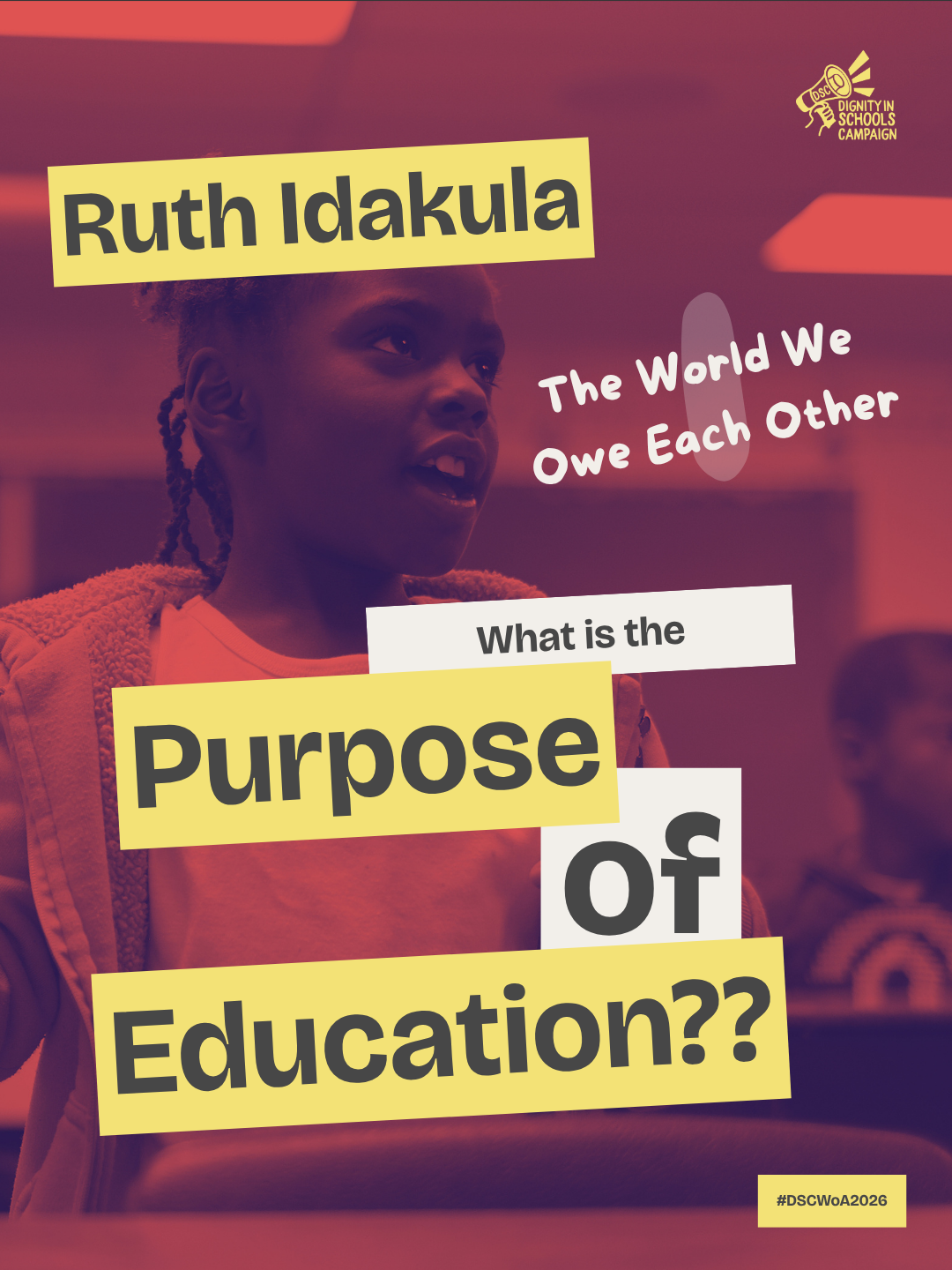
Dignity in Schools Program Director Ruth Idakula offers a powerful exploration on the purpose of education in a society built on inequality, exploitation and organized abandonment. Ruth challenges us reclaim education as a liberatory practice—one that nurtures critical thinking, strengthens our communities, and prepares us to build a world where everyone’s needs are met.
_____
This year marks the 250th anniversary of the experiment called the United States of America. In the year of 2026 more and more people, not just Americans, but people all over the globe are finding that the ideals of what this country claims to be — its vision: freedom, pursuit of happiness, democracy –are more mythology than anything that mirrors reality for the vast majority of people.
We have a Supreme Court that has legalized corruption by ruling that corporations are human beings, and also ruled that while in office, the presidential administration will not face any consequences for blatantly not following the so-called “law”. The wealth gap continues to expand; this current regime is really nothing more than a crime syndicate, and while all of these resources are going to perpetuate war, genocide, and ecological destruction across the world, Americans are desperate for simple housing, meaningful employment with living wages and healthy food! Abolitionist geographer Ruth Wilson Gilmore coined the term “organized abandonment” to describe the intentional divestment from specific communities by governmental and business interests; I think her concept accurately embodies what the average citizen experiences here: precarity, struggle, and limited options for their futures.
I ask myself every day, why does it look like this at this particular moment? The truth is that it was always going to get here. The foundations of the United States of America are that of a colonial enterprise. Chattel slavery was an economic and cultural engine of absolute labor extraction to build what the U.S. has existed as for the past 500 years; a colonizing enterprise which bloomed into a global imperial power. America and ‘Americanness’ can never exist without slave labor — hence the 13th Amendment.
The Dignity In Schools Campaign is celebrating its 20th anniversary this year. This amazing coalition has been fighting for the rights of children who navigate racism and multiple forms of abandonment due to policies that have been championed and implemented by both political parties for decades. Even though there is a canon of work over the years that has helped us understand children and adolescent psychology, in 2026 we pretend that this has not been studied for decades.
2025 marked the 20th anniversary of Hurricane Katrina that obliterated the Gulf Coast in 2005. In the aftermath of Katrina, the entire public school system in New Orleans — my home — was dismantled. Organized abandonment is nothing new. A study by Tulane University shows the deliberate policies implemented to privatize the New Orleans public school system. This has been part of the plan to privatize all of the public goods that are necessary to uphold the social contract. As the Department of Education continues to be gutted, diminished, and dismantled at the Federal level, we are also witnessing book bans, funding cuts, and a sprint towards Christian Nationalism at local levels. We see critically low levels of literacy across student populations. There is a shortage of qualified teachers and support staff and an intense herding of school communities into all things artificial intelligence; all the while, the academic standards keep being lowered. The ability to read and write is a huge factor in determining the trajectory of the life of any child, which is why it is used as a poverty indicator.
The thing that is truly tragic about the state of America’s society is that too many accept and promote the destruction of general quality of life. As I have pondered the “state of the union,” it has become very clear that this regime is a mere reflection of the ideology of a large segment of the population. The truth is this: to believe in the political project of the United States is to support xenophobia, racism, misogyny, and insatiable greed. It is also sadistic in the way it seems to enjoy implementing cruel policies that produce immense suffering, especially on those of us who have the least. As long as this political project continues on its current trajectory, we will continue to experience the freefall of this project and all that comes with it.
In my conversations with my peers, I continually say that U.S. citizens are the most propagandized people on the planet. Large swaths of the population who are generationally poor will continue to advocate the cutting of social services not only for themselves but for everyone else. That’s a profound and particular kind of ignorance. That you would excitedly cut off your nose to spite your face just to make sure another group of people hate, don’t get their needs met.
Where we are is also a consequence of years of liberalism and neoliberalism. The segment of the population that is called “left-leaning” or “progressive” is not politically coherent enough to actually mobilize the policies that lift people out of poverty and support a healthy life course as a human being. Neoliberal policies have actively transferred control from the public to the private sector for decades now and have been one of the cheerleaders for monopoly capital. Both parties in Congress have repeatedly struck down bills that would give Americans universal healthcare, corporate regulation, and a higher minimum wage. When there was a chance to codify Roe vs. Wade, a Democratic administration failed to do so through the Freedom of Choice Act because that was not one of the top priorities of that administration. All of this illustrates that this political system has no real interest in real human rights.
Liberalism serves as an ample handmaiden to fascism by centering the fight to get back to a more digestible “normal” that still serves to uphold capitalism and its exploitation of the masses. The way it shows up in organizing spaces is that often well-meaning people are more concerned about optics than actual impact. For example, some organizing spaces I have been in have a clear hierarchy in terms of ‘sound’ ideas and what “movement work” looks like. There tends to be a lack of deep analytical discussion about why optics matter, why we need mainstream press, and what coverage is going to look like. Years ago there was a direct action protest in New Orleans. It was coordinated by a group that does work around education justice and was run by a young white man. I did not attend the protest, but I remember meeting with him, and he showed me this pristine photograph of him being arrested. Later, I found out that he was showing it to everybody. The pride in the optics was seemingly more important than the goals of the action and the next steps to keep up the momentum.
From my vantage, this is a cultural issue across our organizing spaces, and it is pervasive. Too many movement folks quote Assata Shakur and speak of abolition, but conflate virtual signaling and saying the right catchphrases with activism, and broadcast that to other communities as the only ‘real’ kind of organizing. The only way this position makes sense is if the strategy of building mass awareness outweighs the urgency of organizing everyday people to dismantle state-sanctioned violence. I feel that this is both a conceptual and a tactical error. Issues of effectively challenging police brutality, the for-profit system of perpetual war, mass incarceration, and, of course, the curricular and systemic violence our children endure in the school system are already popular positions held by many; we need the political and social coordination to contest for changes in policy and practice.
So, in terms of where we are in 2026, my question is: what is the purpose of education?
I am a lover of etymology, and many moons ago, I looked up where the word ‘education’ originates. This article speaks to the original meaning and intention of education in the west. It was introduced by the philosopher Plato in The Allegory of the Cave, which serves as an analogy of the human condition. Education essentially is to move humankind out of the “darkness” of ignorance and into the “light” of knowledge. The root “educat” comes from Latin, which means “to carry” or “guide out”. Education is supposed to be liberatory. It is to guide us out of the shadows of ignorance, and as the article says, “illusion, delusion and superstition”. It also says, “education is: allowing the innate ability to understand reality, to develop the capacity that does not have a merely discursive function, but a soteriological purpose of first importance. Only by developing this faculty, which is the essence of education, humans may be free.” Another root of the word is educere, which means to “lead from” “out” or “forth” –as I write this, the level of AI that I have to circumvent speaks to exactly why I chose to write this- indicates that we all have something that needs to be pulled out of us that we can offer our communities. Education is not just about training people on what to think, but more about how to think. It is to build character, to orient students to the world we live in, and to positively contribute to that world. It is to bring understanding to our connection to those around us and the world in general.
To move ourselves outside of the western world, most indigenous societies have a rite of passage process that serves as a core function of education. `It is a ritual that is a process of transformation and to celebrate milestones in your life. Here again, it is to orient young people to their community, their place in it, and how we will sustain it together.
Over the past five centuries, as Western impositions of education have travelled the globe through colonialism and imperialism, education has slowly become a way to train people into compliance as opposed to nurturing critical thinking, character development, and participation in larger society. Modern Western education may serve some of us intellectually, but it does not grow a whole human being. It is often individualistic and serves the purpose of maintaining the status quo. It does not build empathy and compassion, or the understanding of the impacts of decisions on those around us or future generations. It does not build a sense of collective growth towards social, economic, and political welfare. Your place in the empire is to serve the empire, and that is all.
So, what do we do?
- We engage more in political education. That can look many different ways. Start a group where you pick a piece of media to watch, read, and discuss within a group. Create a culture and space for ideas, disagreements, and learning to flourish. It. There are social movements here and all over the world that have engaged in systemic change that has actually been successful. By becoming conscious students of history, there is no need to re-invent the wheel on what to do.
- I am glad to see that more and more people are engaging in the discussion of mutual aid. As the government continues to siphon off public resources to enrich themselves, it is vital that we support and build locally. For example, after Hurricane Ida in 2021, neighborhoods across New Orleans had refrigerators donated by ordinary folks where everyone could either put food in the refrigerators or go get food. It was amazing to see. People, including myself, cooked full meals to share on a regular basis. Unfortunately, none of those refrigerators exist today, but it certainly got people through some really tough times. Remember, the economy is also local.
- U.S. popular culture has ensured that consumerism is our idol. Everything that is marketed to us offers only a commodity or a transaction, and we are addicted to this drug. As long as we continue to assume that these corporate returns for investors are synonymous with social progress for us, then our words and actions do not mean a thing. I realize this is not an easy thing. We need to organize boycotts.
- In preparation for revolutionary work, we need to re-examine our relationship to the words ”safety” and “violence”. There is no way to make this place a better place to live without understanding this. We tend to internalize what the state defines as violence and safety, for that matter. Recently, there have been places all around the country that are tearing down flock cameras. This article is a good example of the way safety and violence are presented to the general public. The cameras are part of a rapid move to a police state. Even the name of the company is Flock Safety.
In conclusion, I ask that anyone who reads this piece examines what education means for you, for your loved ones, and your community. Dare yourself to create the harmony and loving community we all deserve, where our needs are met, and we can dare to be human.