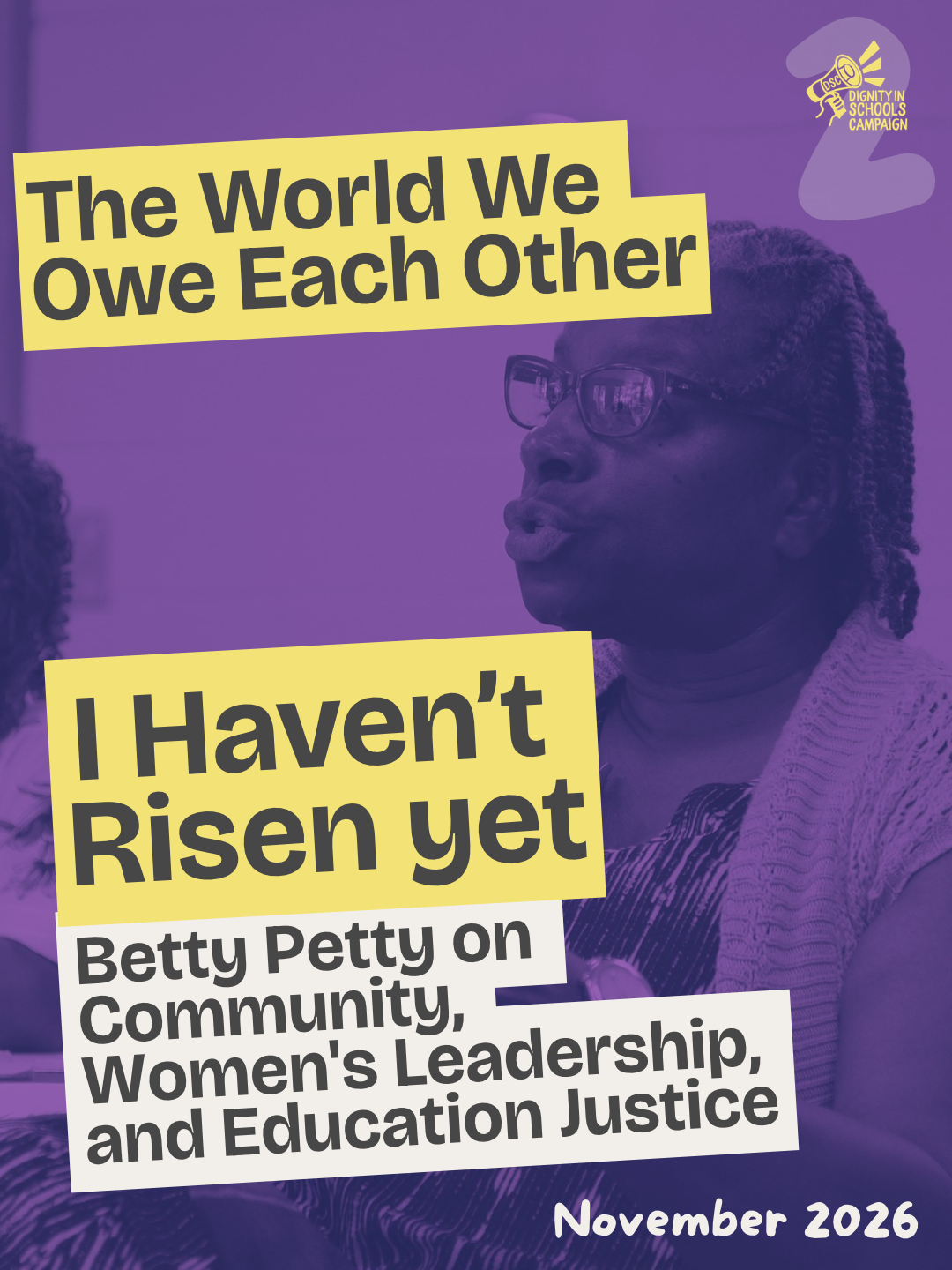
From the lessons of her parents to the freedom fighters of Mississippi, veteran organizer and parent advocate Betty Petty reflects on the generations of struggle and social movements that shaped her work, the importance of bringing families into education decision-making, and why none of us can truly rise while our communities are still struggling.
*This is a transcript of an interview Betty gave to DSC in spring 2026. It has been lightly edited for flow and readability.*
My name is Betty Petty. I am a parent and parent-student advocate from Indianola, Mississippi. For more than 30 years, I have worked with parents and students, helping families understand their rights and the rights of their children.
That work takes all of us. When a child has an Individualized Education Program, or IEP, we have to make sure its guidelines are followed and that teachers understand the child’s disability and how it may affect them in the classroom. I help parents understand the process and review their child’s records so they can take part in decisions. I always tell parents: there are no dumb questions. Whatever you need or want to know about your child, ask. An IEP team is supposed to make decisions together. No one person should make those decisions alone.
My understanding of this work goes back to my parents. Neither of them had the opportunity to finish high school, but they always told us they wanted better for us than what they had. They made sure their 12 children went to school and got an education. Growing up in a large family taught us to share and make sure no one was suffering when something could be shared. That is where unity comes from.
I was also shaped by my fourth-grade teacher, Mrs. Sarah Ware, and by the freedom fighters in my community. Every Saturday, people met at the little Catholic church on Church Street and marched to the courthouse, fighting for our rights and for the generations coming after them. I remember people like Nelson Dotson and his wife, Carver Randle, and Mack Lawrence. I also remember Fannie Lou Hamer, who lived in Ruleville and brought people from there to the Indianola courthouse to vote.
Registering to vote was not easy. People were made to face tests and guess how many items were in jars. People literally died so that we could have the right to vote. That is why I tell younger people not to say their vote does not count. Decisions are going to affect you whether you vote or not.
Those experiences taught me that school is school, but school is community. And the last five letters in community are unity. We need to be together and help one another progress.
I am still in my community, looking at the people coming behind me. How do we help them understand history? History is your story. We have to understand where we came from and where we are now, and then pass the torch. The struggle is still going on. I am not free until my sisters, my brothers, and my community are free.
When we organize, we bring young people—11 and 12 years old and up—to the table. We want them to have a voice in how they would like to see their community in 10, 15, or 20 years. They need to understand where we have come from and help shape where we are going.
Technology is needed, but sometimes we have to go back to the old way and pick up a book. Not every child has a computer, reliable internet, or transportation to a place where they can use Wi-Fi. If a child cannot complete an assignment because they lack those resources, that does not mean they do not care or are not trying. We have to remember where we are, what we have, and what we don’t have.
Teachers have a responsibility to make sure children get the tools and skills they need. I tell people in meetings that we must not forget: these are our babies. When children succeed, we all succeed. It takes all of us working together.
I believe the way women’s contributions are recognized is a matter of power. In organizations in my community, I have experienced people wanting to silence me when I speak about education. But I will not allow someone to tell me I cannot speak. When I go into a meeting, I have to have facts. I cannot go in based on assumptions. I am there to educate our people, because when people are educated, they are able to do some of the things that need to be done.
There is an expectation that women are supposed to be quiet and silent. But when you look at what is happening in our communities, it is women who are leading, bringing people together, and organizing. You cannot do everything without a woman putting her touch on it. We can get more done by coming together, talking, and reasoning together. To me, this is not about power. It is about unity.
Some people may get certain letters behind their names and feel they have risen. But I look at it differently:
“I haven’t risen if I still have my people in the background, still struggling. I haven’t risen yet. I just got something of what I needed. But how is it that I can help others to get what it is that they need as well?”
I never want to forget what my parents did for me or what my community did when we may not have seen a way out. When we get where we want to be, we should not get there by ourselves. Take somebody else along with you. We cannot rise alone. Let us not be separated. Let us not be divided. Let men, women, and children stand together, fighting for the same cause.